| |
Battery Types and Comparisons - VRLA vs GEL vs AGM
Flooded Valve Regulated Lead Acid Batteries (VRLA)
Gelled Electrolyte Lead Acid Battery (GEL)
Advanced Glass Mat Battery Construction (AGM)
Today, there are three distinct types of lead acid batteries manufactured and any one type can be designed and built for either starting or deep cycle applications. These types are flooded acid, gelled acid, and Advanced AGM (Absorbed Glass Mat). There are various quality levels available in each type. Price is dependent the product design, processing, and manufacturing costs. This includes the amount of lead, purity of that lead, methods of pasting and curing the plates, degree and type of inter-plate insulation, quality of the case, and the sealing method used. Generally, high quality means higher cost.
Flooded Valve Regulated Lead Acid Batteries (VRLAB)
The oldest types of lead acid batteries are flooded cell types. These have been around for decades and evolved from wooden box models into the plastic valve regulated models on the market today. The electrolyte in these batteries is liquid sulfuric acid solution. This stuff is pretty corrosive and has destroyed more than a few sets of clothes and pieces of RV gear. VRLA flooded batteries generate and vent dangerous explosive gases through their valve regulation and must be vented to the outside world. These batteries also acid "mist" during charging and discharging. This leads to the corrosion of their terminals, and often-acid damage to surrounding surfaces. (look at your car battery for an example) VRLA Flooded batteries must be installed upright, can leak that acid, and require regular watering. Should they fail to be watered, they will not perform to spec. That all being said, they are also the least expensive type and therefore are the choice of many renewable and RV owners.
Gelled Electrolyte Lead Acid Battery (GEL)
The next types of batteries are gelled acid (Electrolyte) designs. They were introduced to American RVs and Marine enthusiasts by Sonnenschein of Germany over 30 years ago. Their introduction and widespread adoption was due to their increased efficiency and designed safety features. Their acid is immobilized by adding "fumed" silica to the sulfuric acid solution and then sealing the battery. They internally recombine most of the gases (hydrogen and oxygen) generated during charging and are maintenance free due to this.
Gelled electrolyte battery designs are generally quite old and few engineering options are left to improve them. Gel electrolyte is highly viscous and during charge and discharge the gel can develop voids (pockets) or cracks when the amperage is increased. These pockets impede acid flow and result in the loss of battery capacity. Also the gelled mixture can liquefy upon charge due to the shearing action of gassing (this property is called "thixotropic"). After termination of charge, it can take an hour for the acid to gel again. During this time liquid is moving and the battery can leak if any opening has developed. Last, gel batteries may store hydrogen gas that has not recombined. When overcharging causes a gel battery's vent caps to open, explosive gasses may be vented into the battery compartment. This vented hydrogen has caused a number of "fast failures" or battery explosions.
Advanced Glass Mat Valve Regulated Sealed Lead Acid Battery Construction (AGM or VRSLAB )
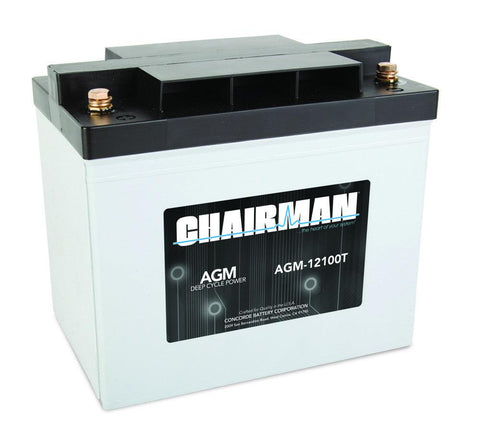
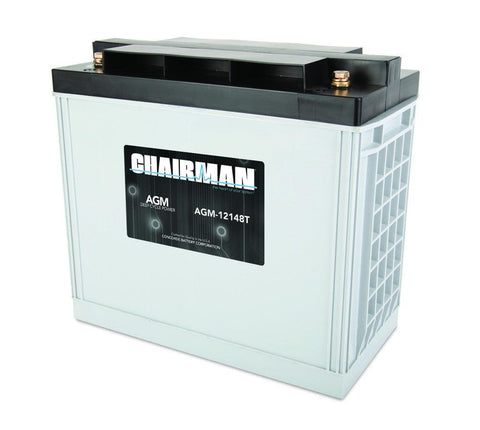
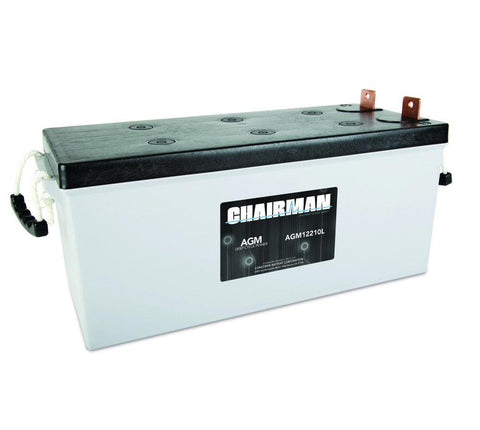
The latest and most advanced battery technology is Advanced AGM VRSLAB batteries (Advanced Glass Mat, Valve Regulated Sealed Lead Acid Batteries), which were developed to provide increased safety, efficiency, and durability over all existing battery types. In Advanced AGM batteries the acid is absorbed into a very fine glass mat and held in place by capillary action. This construction technique, in coordination with double wall design, and sealing has many advantages. There is never a way to make the acid free to slosh around. This allows for installation at any angle, and has lead to DOT exemption for USPS, UPS, and Fedex.(department of transportation)By keeping the "moist" with electrolyte, gas recombination is more efficient (99% AGM). This leads to fewer incidents of exploding batteries than either of the 2 types above.
Since the AGM material has an extremely low electrical resistance, the battery delivers much higher power and efficiency than other battery types.
Since the AGM material has an extremely low electrical resistance it can crank more amps in and out without cost to life. AGM batteries are rated at 100% their capacity for charging and discharging amperage. (compared with roughly 35% for gel and flooded models)
Less acid means a lighter battery
Advanced AGM batteries offer exceptional life cycles by far better than either gel or flooded batteries. This leads to longer battery life and increases your ROI
A few more things to take into consideration - purity of the lead, and the construction of the battery.
Pure Lead: (99.999% pure or "triple 9") The manufacturers we choose to list only use this quality of materials in their products. Quite simply, recylced lead in batteries is not as chemically able to absorb charge. The pure lead can be as much as 20% more likely to chemically sustain a charge. *Please recycle your battereis. Recycled lead is great for many other applications and is best for the environment.
Hand Soldered Cells: Lead is an extremely porous metal, and this leads to inconsistencies in the soldering of 2 lead parts. Hand soldering is by far the most effective, and time honored practice to join this metal. In the last few years, several companies have pioneered machines for soldering designed to vary each and every weld to meet spec. These systems are becoming increasingly more accurate and are becoming acceptable for low vibration and stationary installations. Both
Sun Xtender and Lifeline batteries are Hand Soldered here in the United States and quality inspected prior to charging, and delivery.
Rolls - Surrette Batteries are soldered by machine, but are rigorously tested out as the highest quality flooded batteries available.
Dual Wall Construction:
Oil Tankers are required to have two hulls to keep oil out of the ocean. Batteries should have 2 walls to keep the acid out of living room. In addition, the space between the hulls should be used to recombine the gasses produced during electrolysis to reduce the explosive nature of the installation. Sun Xtender and Lifeline Batteries both employ this double wall design leading to a further margin of safety and durability.
AGM Batteries Available
All Available AGM Batteries
Battery Comparison Table - AH & Capacity
Battery Comparison Table - Size Weight

Lifeline Deep Cycle AGM Battery Specifications
Lifeline Deep Cycle AGM Batteries by Size
Lifeline OEM - RV & Marine List
Lifeline AGM Battery Features
Lifeline AGM Battery Performance Graphs
Lifeline AGM Battery Charging Procedures
Lifeline AGM Batteries History
AC - DC Lifeline AGM Battery Bank Sizing Calculator
DC - DC Lifeline AGM Battery Bank Sizing Calculator
AGM Battery Users Manual Part 1 (1 of 2)
AGM Battery Users Manual Part 2 (2 of 2)

Sun Xtender Deep Cycle AGM Battery Specifications
Sun Xtender Deep Cycle AGM Batteries by Size
Sun Xtender AGM Battery Features
3rd Party Sun Xtender AGM Battery Test Results
SunXtender AGM Battery Charging Procedures
Sun Xtender AGM Batteries History
Sun Xtender Battery Service Instructions
Sun Xtender Technical Documentation
AC - DC Sun Xtender AGM Battery Bank Sizing Calculator
DC - DC Sun Xtender AGM Battery Bank Sizing Calculator

Optima Battery Features
Optima Red Top Battery Specifications
Optima Red Top Batteries by Size
Optima Blue Top Battery Specifications
Optima Blue Top Batteries by Size
Optima Yellow Top Battery Specifications
Optima Yellow Top Batteries by Size
|

Total Power Racing Battery Features
Total Power AGM Racing Battery Specifications
Total Power Racing Lightweight Batteries by Size
Battery Chemistry Comparison - VRLA vs GEL vs AGM
Comparison Between Gel Batteries and AGM Batteries

Rock Racing Battery Features
Rock AGM Racing Battery Specifications
Total Power Racing Lightweight Batteries by Size
Battery Chemistry Comparison - VRLA vs GEL vs AGM
Comparison Between Gel Batteries and AGM Batteries
Shipping, Safety, and Legal
Lifeline, SunXtender, Total Power, and Rock Racing Battery Material Safety Data Sheet - MSDS (pdf)
Lifeline, SunXtender, Total Power, and Rock Racing Battery Safety Bulletin
Lifeline, SunXtender, Total Power, and Rock Racing Battery Transportation Information DOT
AGM Battery Applications and Benefits
AGM Battery Efficiency and Peukert Coefficients
Custom Uninterruptable Power Supply - Custom UPS
Uninterruptable Power Supply Kits - UPS Kits
Solar Powered Off Grid Housing
AGM Battery Installation Considerations
Hydrogen Venting Systems
|
|
|
|