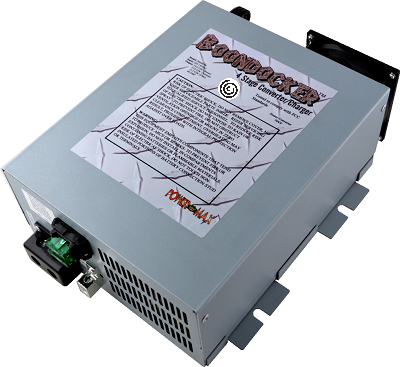
First off, insure that your battery charger is a safe power module. This is crucial, your charger should be certified by an independent
testing laboratory such as UL, ETL, CSA, etc., and
stamped accordingly. This is your assurance that it
be safe, will meet the manufacturer’s specifications,
and will be approved in an electrical inspection. There
are different design and rating standards for various
application environments (buildings, vehicles, boats,
etc.). These also vary from one country to another.
The task of the charger is to recombine the active material; sulphuric acid (H2SO4), lead (Pb) and lead oxide (PbO2) from the lead sulphate (PbSO4) that has been generated during discharge. Lead sulphate is a normal byproduct of the discharge cycle, and is the same material that causes the battery life ending condition, sulphating. Lead sulphate is necessary throughout the entire process, but it when the sulphate crystals grow to a significant size, they are not as easily broken down in the charging process, and the trouble begins.
90% of the battery chargers on the market are guilty of voltage and current rippling. This can have catastrophic consequences when it comes to the life of your battery, and the available charge that it contains at any time. Many a charger misread a battery's state of charge due to it's own voltage oscillations. For instance a linear charger at 9.7 amps gives a voltage ripple with 2 volts at a mean voltage of 12.5V. The subsequent noise can be heard in a radio, speaker, or other audio device. The same linear charger as above,
has a current ripple of 40 amps
at a charge current of 9.7 amps.
This combination has catastropic consequences when charging AGM batteries.
40A peak current and below 10A mean current gives a current ripple above 400%. Most manufacturers of VRLA batteries (see battery types) recommend that this value should be below 5%. A traditional charger should therefore not be used for these batteries.
One reason for the damage is the heat factor. A charger with 400% current ripple can be regarded as a charger that charges 4 times the average current for a quarter of the time and with zero current for the remainder of the time. The result is that resistance heat is four times as high using a charger of this type compared to a quality charger.
The test was conducted in CTEK's labs.
Interruptions, rippled voltage, and rippled current may damage equipment connected to the battery as it oscillates, some items routinely affected are:
Audio equipment in cars.
Telephone equipment in RV's.
GPS and navigational aids in boats.
Sensitive equipment in emergency service vehicles.
Can you really connect and then forget about the charger?
Always check that the charger has switched to maintenance charge before leaving your charger unattended and connected for longer periods. If the charger has not switched to maintenance charge within 72 hours, the charger must be disconnected manually.
Otherwise, if the charger has switched to maintenance charge, everything is as it should be and the battery is probably healthy and will work for a long time together with your smart battery charger.
If the charger has not switched to maintenance charge after 48 hours, this is a sign that something is wrong, you used a whole lot of juice, or you have a problem.
Possible causes:
* A larger battery of an older type, known as an antimony battery behaves differently, see Charger Knowledge, Battery Types.
* If major power consumers are ALWAYS connected to the battery, charging will take a long time and the battery can even be overcharged.
* The battery is sulphated from the start, see Sulphating below. In this case, charging will take longer as the higher internal resistance of the battery restricts the amount of current it can receive.
* The battery is spent and needs replacing.
As the lead sulphate in a battery builds, the speed with which it takes a charge is reduced. This problem baffles older "timed" charging cycles, is difficult for primary chargers, and leaves your battery less than charged. To fix the problem, a number of thinking manufacturers have developed computerized charging cycles to accomodate, and adapt to the battery being charged. The CTEK and Xantrex TRU Charge models are especially good at charging a battery through such issues and returning it to normal operation. AGM batteries should not be equalized, simply continue to feed them current (amperage) at the prescribed voltage (14.4 for 12 volt batteries) until their open circuit voltage reaches the proper reading (13.10 volts).
BD Batteries - A Broomfield-Designers Company
Serving the Local Colorado Community 9-5 Mountain & Emergencies P. 303-800-4725 F. 303-600-9726
Serving the Buffalo and the Great Lakes Communities 9-5 Eastern & Emergencies P. 716-531-4875
Mailing Address: 5023 West 120th Ave. #138, Broomfield, CO 80020
OUR DENVER WAREHOUSE IS MOVING TO A NEW LOCATION AT THIS TIME.
WE WERE SCHEDULED TO REOPEN OUR BRICK AND MORTAR BATTERY WAREHOUSE IN EARLY 2011.
IN THE MEAN TIME OUR WEBSITE AND PHONES OPERATE FINE!
We do thank the public for the outreach of concern, and votes of confidence.
Do call Lorene prior to schedule used battery pickups, new battery dropoffs, etc. by appointment.
The information contain on this deep cycle AGM batteries website is deemed reliable, but not guaranteed. Please verify specific information on marine AGM batteries, rv AGM batteries or auto AGM batteries listed here by calling us direct. We are proud to offer the highest quality AGM batteries and hope you will consider using our deep cycle AGM batteries in the near future!